
Life is a Different Category
primordial man, zen blindspots, The Snow Leopard, and choosing life over death
For those of you who prefer to read off paper rather than a screen, I have converted this entry into an easily printable pdf file:

Paid subscribers will receive a printed version of this entry via post in a future mail-out.
I.
Many of you will have heard C. S. Lewis’ ‘argument from desire’. He used a version of it in a few essays and lectures, but its most famous formulation is:
“Creatures are not born with desires unless satisfaction for these desires exists. A baby feels hunger: well, there is such a thing as food. A duckling wants to swim: well, there is such a thing as water. Men feel sexual desire: well, there is such a thing as sex. If I find in myself a desire which no experience in this world can satisfy, the most probable explanation is that I was made for another world.”
I’ve known that passage for years, but never leaned that deep into it.
But then one day, late last year, I was lying in the shade of an Australian summer’s day with my infant son sleeping on my chest, and I had a rare experience of pure connection to the creation surrounding us. It’s difficult to describe, but at the time, I jotted down this stream-of-consciousness note which gives you a sense of it:
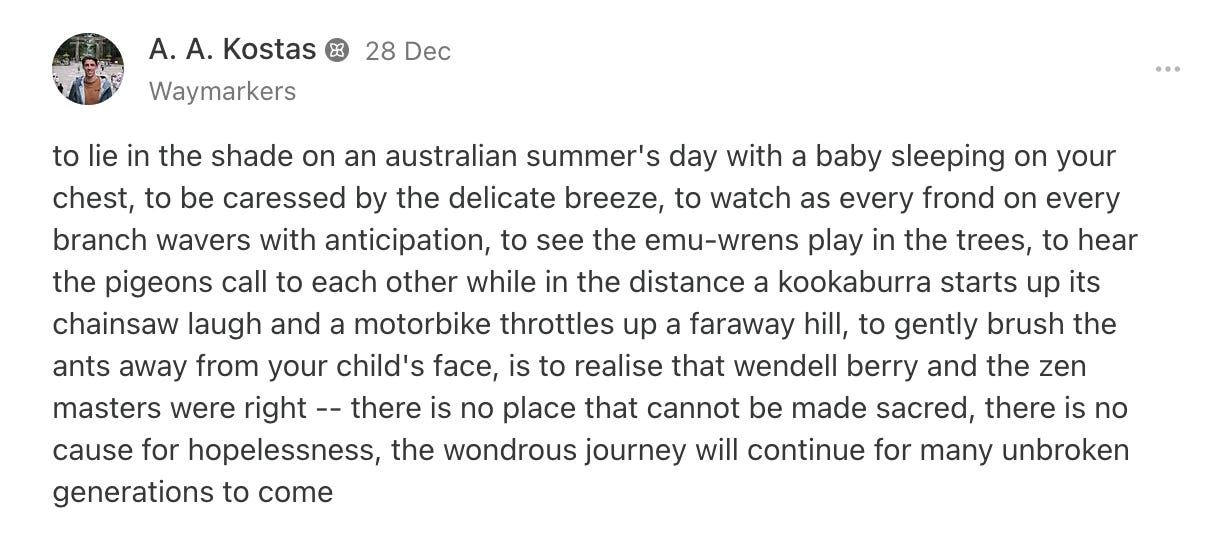
And as I dwelled on this sensation — this truth that I felt more than knew — I realised that I desired two things:
To be in communion with the great spirituality and love that underpins the entire universe, to meet and know and love and be loved by the Creator and Author of all things; and
To be at one with this Creation, to cease to be disconnected from the very world I was born from and placed within.
Lewis’ quote above deals with the first desire, but there is more I want to understand about the second desire, and how it fits together with the first desire.
II.
I think often of primordial man: the indigenous huntsman who knows the forest, knows every living creature within it, is so enmeshed in his world that he is not separate from it. His thoughts are the thoughts of the forest, his mind and body and soul are of the forest, and so every part of him is in communion with the world, with creation, and with the Creator. This is how I picture Adam and Eve, before the fall, before the grasping at godhood.
Isn’t it interesting that the Germanic languages developed the word ‘bear’ (literally, ‘the brown one’) due to a taboo of speaking the beast’s true name (likely ‘h₂ŕ̥tḱos’ in Proto-Indo-European, which is where the Latin ursus and Greek arktos come from)? A fear that the true name could summon the dangerous animal. And the Israelites avoided speaking YHWH’s name directly, preferring ‘El’ or ‘Adonai’ out of a holy fear, which can be a form of respect but can also be distancing, a disconnection from the source. We lose something when we distance ourselves from reality. Language can be a screen between us and the real thing.
Returning to prehistory, I do long for when man’s mind was one with creation, when he could name the creatures with their true and proper names without need for code words or innuendo. When meeting God in the cool of the evening was no strange thing, for man was himself the meeting point between the living creation and the creator. Man the linchpin, apex of the entire tangled ecosystem.
I long to find my way back to that position.
III.
From a big-picture view, everything in the universe can be divided into two categories — Living and Non-Living. The stars and the nebulae and black holes and cosmic suns and planets and moons and mountains and oceans — they are the Non-Life, the inanimate. Made up of the same atoms as you or I, particles churning and whirling through multitudinous forms, but not Living. Non-Life trends quickly toward entropy and disintegration. There is no true growth, just phases of burning out.
But Life — which as far as we know, only exists upon our tiny planet — trends toward complications and complexity, bursting festoons of trunks and leaves and limbs and eyes and mouths and petals and fins and wings and hair and skin. Life confounds the equations of the physicists. Life at the sheer volume and creativity that exists on our planet is difficult extrapolate from first principles, it should not occur when we run the equations. It is vastly improbable.

IV.
When exploring what it truly means to be connected to the universe, I find that Zen Buddhism and Taoism can be helpful (Thomas Merton and D.T. Suzuki’s exchange in Zen and the Birds of Appetite is particularly helpful).
Zen Buddhism is comfortable with equating God with the things I have termed ‘Non-Life’. God is the ocean, but God is also the beach the ocean crashes against. God is the mountain, but God is also the sky the mountain strains toward. And I think there is wisdom in these metaphors. An all-powerful deity is impossible for us to grasp conceptually, so we turn to immense and unshakeable things as a picture for what God is like. Hence the sun worship of so many ancient cultures, or the proliferation of storm gods. This picture of God gets close to ‘the Cloud of Unknowing’ of Christian mysticism, a God so infinite we cannot possibly grasp Him. A Zen master would point out that an infinite God is not so different from a God of the void. God as eternal nothingness. God as uncreated darkness as much as uncreated light.
But Eastern religions go further in their exaltation of Non-Life. In essence, they teach that each one of us contains everything, all of creation, within ourselves. This is a crippling, mind-crushing thought, and if it’s true, then our natural reaction is to wish to be like the mountain — impassive, eternal, immovable. Hence the emphasis on meditation, of remaining in the present, of not being crushed by the weight of the entire universe experiencing itself. If God is a void — a Non-Living mountain pressing against an empty, Non-Living sky — and you are the entire universe experiencing itself, then becoming like the Non-Living mountain is the only way to deal with the unbearable heaviness of being.
V.
On the other end of the spectrum from the Zen approach, we have Western Enlightenment thinking — cooly rational and pragmatic. Many of you live in the shadowlands of the Enlightenment. You are encouraged to become the best and most effective tool you can be. Don’t just wield technology, become it; and if you can be anything, be a powerful, agentic tool. We shouldn’t sit still and remain in the present, we should effect change in the way a tool does, by slicing and cutting and chopping.
I find it fascinating that both the Zen approach and the Enlightenment approach render us static and inanimate, for both views lead us toward Non-Life. A tool is no more alive than a mountain. If we follow either approach — Zen negation or Enlightenment toolishness — we risk becoming disconnected from the very category we are supposed to be the prime exemplar of: messy, organic, biological Life.
VI.
Some waymarkers exist to show you where not to go, to give an inkling of the dangerous terrain ahead. Warning you away from a tempting path.
The Snow Leopard by Peter Matthiessen was like that for me. It’s a brilliantly written book, and having visited Nepal myself, Matthiessen captures the place and its people. But despite the adventure he embarks on, his self-absorption and inward-facing spiritual goals are constantly on display.
I’ll admit, there are many arresting passages that reveal deep truths, such as:
“The Universe itself is the scripture of Zen, for which religion is no more and no less than the apprehension of the infinite in every moment.”
and
“The child was not observing; he was at rest in the very center of the universe, a part of things, unaware of endings and beginnings, still in unison with the primordial nature of creation, letting all light and phenomena pour through.”
But then we get to the more typical riddle-koans of Zen Buddhism, which frustrate more than they aid, and which seem destined to lead us into entrapping quicksand:
“And there comes a piercing intuition, by no means understood, that in this feather on the silver path, this rhythm of wood and leather sounds, breath, sun and wind, and rush of river, in a landscape without past or future time — in this instant, in all instants, transience and eternity, death and life are one.” (emphasis mine)
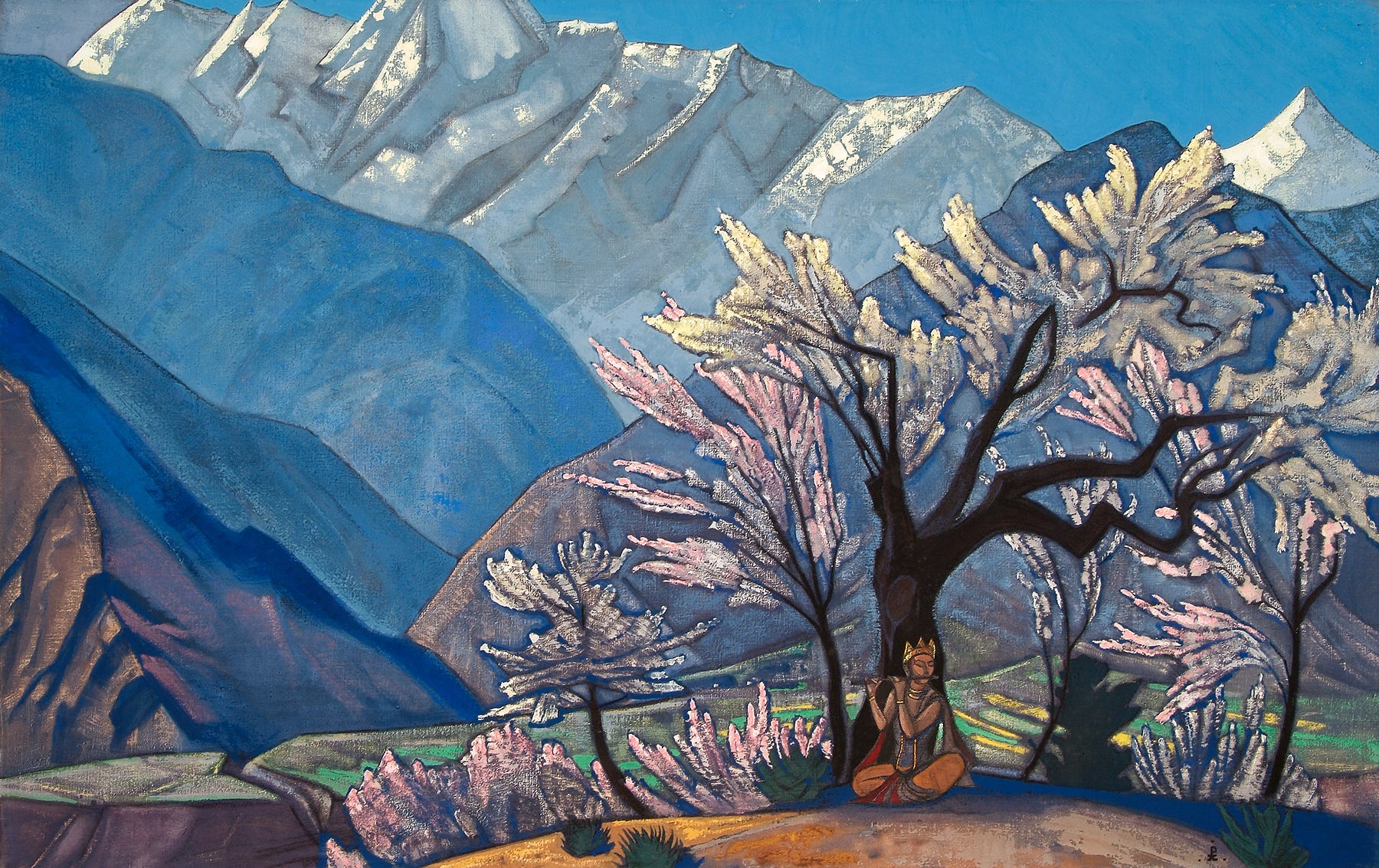
What can it mean, for death and life to be one? The essential division, which underpins all other binaries — death as the 0 to every living 1 — is erased for Matthiessen while he’s in the thrall of Zen teachings. To erase this ultimate distinction, the fundamental reality of creation, that death and life are diametrically opposed, would leave most people totally unmoored from any sense of reality — which is what happens to Matthiessen. Traipsing through the Himalayas, literally at the ceiling of the world, he consistently ignores the turmoil of grief he feels in the wake of his wife’s recent death, and also pushes away all thoughts of his young son who he has left behind to go on this expedition (in effect rendering his son both fatherless and motherless). And up there in the Himalayas, Matthiessen experiences a kind of spinning transience which sends him reaching out toward the mountains. He imagines that the Non-Life of the mountains, their godlike nature as created objects which radiate permanence, will somehow ground him if he can just become like their solid snowy peaks. If he can just trade his Life for Non-Life. Over and over he finds himself drawn to the soaring giants:
“Snow mountains, more than sea or sky, serve as a mirror to one’s own true being, utterly still, utterly clear, a void, an Emptiness without life or sound that carries in Itself all life, all sound.”
and
“The secret of the mountains is that the mountains simply exist, as I do myself: the mountains exist simply, which I do not. The mountains have no “meaning,” they are meaning; the mountains are.”
VII.
A few years ago I had a strange experience involving a tree in my parents’ backyard, which is difficult to explain without sounding crazy. So instead, I wrote a poem which provides a small window into the experience (and which Calla Press were kind of enough to publish in their anthology last year):
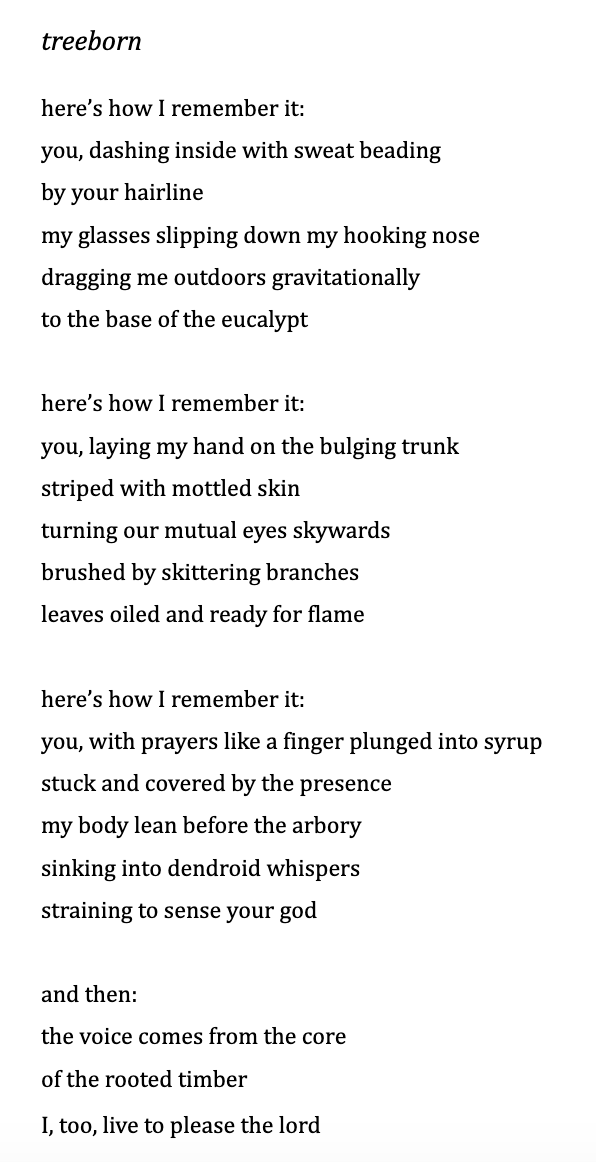
This poem reflects the fundamental truth about nature which the pagans and Eastern religions get right: nature is a spiritual ecosystem which we are supposed to be connected to, in a relationship of love and respect.
VIII.
In The Snow Leopard, the two major narrative questions are whether Matthiessen and his fellow expeditioners will sight the elusive snow leopard (no spoilers from me on that one) and whether Matthiessen can grasp the meaning of the koan uttered by a Zen teacher before his journey, the answer to which will apparently bring him salvation. The koan is a classic Zen absurdity:
“All the peaks are covered with snow — why is this one bare?”
Matthiessen tussles with this koan just as he tussles with his own desire to see the snow leopard. What would it mean to have seen the snow leopard, or to have relinquished the desire to see the snow leopard? Here’s how Matthiessen ultimately resolves it:
“I meditate for the last time on this mountain that is bare, though others all around are white with snow. Like the bare peak of the koan, this one is not different from myself. I know this mountain because I am this mountain, I can feel it breathing at this moment, as its grass tops stray against the snows.”
His answer is to imagine Non-Life as being alive, to imagine the mountain is like him and he is like the mountain. To make God in his own image.
IX.
I do not want to be a Non-Living mountain, and I do not want to be an Enlightened tool. What I do want, very much, is to be a human version of the tree from my poem. To find my way toward the culmination of every Living thing that surrounds us, and to learn what it means to be the only Life which is given dominion over all other forms of Life. I know, or I’m learning, that this dominion involves serving all other parts of creation in order to gain back the respect and allegiance which is our birthright.1
X.
It’s become fashionable to view humanity as a problem for the natural world, that we are a ‘cancer’ which needs to be eradicated or mitigated in order for creation to flourish. This is understandable, given how badly we have been acting for the past few centuries, but it’s fundamentally flawed. For all our grasping at godhood, we are terrified by the idea of our true godlike calling, which is to be good gods here on our planet, to be the meeting point between heaven and earth, between Life and the Creator.
If we are to accept the weight of responsibility of being godlike, if we are to once more walk and talk with the Creator in the cool of the evening, flitting between the shadows of the primeval trees which bow and shift around us, then that will only come by being fully alive, by sinking into the truth that our created flesh can be holy. That the animals and trees and plants around us also live to serve and be served, that we aren’t souls trapped in fleshy prisons, but instead we are the zenith of the most rare and beautiful category of existence that has ever been dreamed of. We are of this creation, and yet we are drawn up to the peak of it, so that we can be an essential part of its ultimate fulfillment and redemption.
This is the way of Life.
Beautiful piece, brother. Same page.
Great piece and amazing poem. Thanks!